
- Laura Owen
- 21 August, 2026
- 12:16 pm
- 0 comments
A Lucky Little Bat at Tambo Bluff!
There’s something special flying about in the night skies at Metung — and we’re excited to share the news with you!
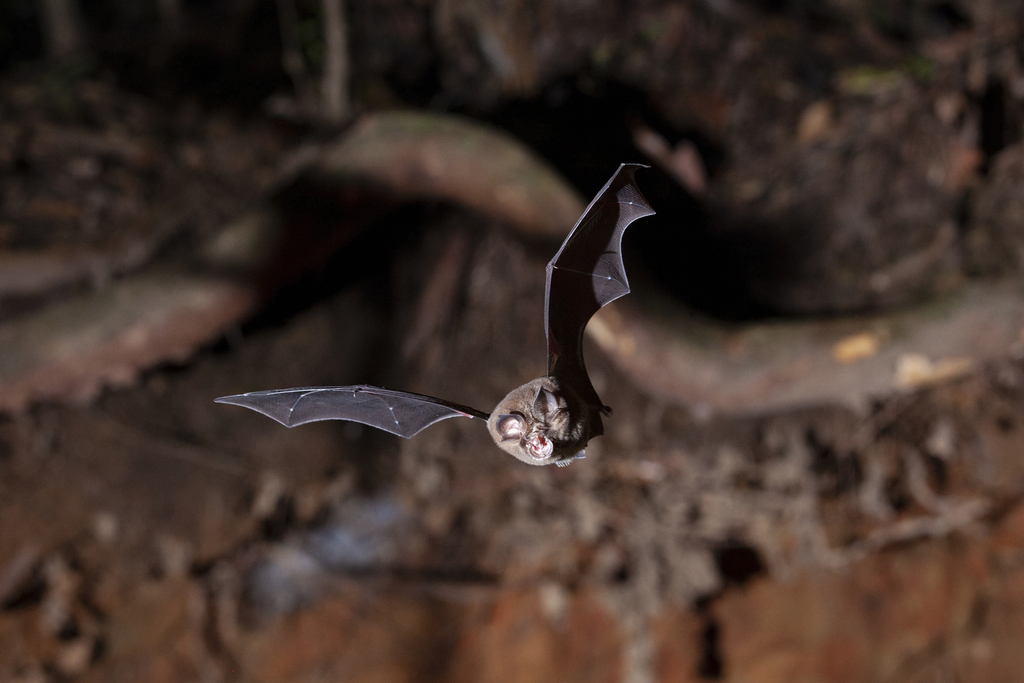
This year, the endangered Horseshoe Bat (Rhinolophus megaphyllus megaphyllus) has again been detected utilising the remnant bushland at Tambo Bluff. Aptly named for its distinctive, horseshoe-shaped nose, this tiny microbat is a remarkable little creature and an exciting detection for the local environment.
Below: Eastern Horseshoe Bat (image credit © Brett Vercoe (CC BY-NC) 2019 iNaturalist)
A world we can’t hear
Microbats often live around us, but they can easily go unnoticed. Their small size makes them difficult to spot, and the majority of the calls they use are too high-pitched for human ears to hear.
So, how do we know they’re there?
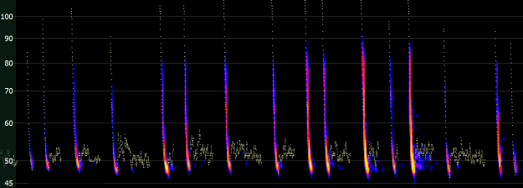
At Wildlife Unlimited, we use a combination of harp trapping and ultrasonic detectors to uncover the secret lives of these nocturnal mammals. Ultrasonic detectors give us ears into the bat world. They pick up the echolocation calls that microbats use to navigate their surroundings and hunt their insect prey. The recordings can then be transformed into a visual representation called a spectrogram, allowing us to see the unique patterns of their calls.
The Horseshoe Bat has a call that really stands out!
Listening for a Horseshoe Bat
Horseshoe Bats produce a particularly distinctive echolocation call, with frequencies reaching an impressive 66–70 kHz — well beyond the range of human hearing (we can hear at best up to 20kHz).
These specialised calls are perfectly suited to their hunting style. Horseshoe Bats can manoeuvre through dense vegetation and cluttered spaces, using echolocation to seek out moths and other insects hiding amongst the foliage. They may be masters of manoeuvring, but there is a catch. Horseshoe Bats can be relatively slow flyers and come close to the ground, which can make them vulnerable to predators such as foxes, dogs and cats. Finding an endangered Horseshoe Bat at Tambo Bluff provides valuable evidence that this patch of habitat is supporting species of conservation significance.
Every detection helps us build a better understanding of which species are living here in East Gippsland, how they use the landscape and what we can do to protect them.
So, the next time you’re out at Tambo Bluff as the sun is setting, remember — while you might not see or hear them, there could be tiny wings flying through the darkness above you.
And somewhere out there, a lucky little Horseshoe Bat is getting on with the important job of keeping our insect populations in check.
Microbat echolocation spectrograms

Above: Eastern Horseshoe Bat (Rhinolophus megaphyllus megaphyllus). Their echolocation call is particularly high pitched, the frequency can be seen on the Y-axis
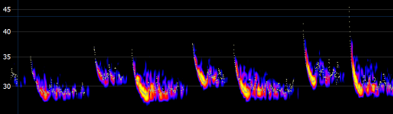
Above: Goulds Wattled Bat (Chalinolobus gouldii) - note that the shape of this spectrogram differs from the one below despite being the same species.
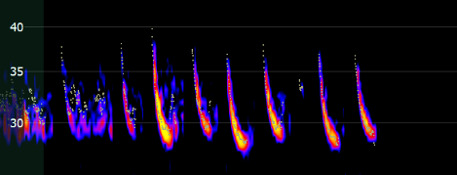
Above: Goulds Wattled Bat (Chalinolobus gouldii) - echolocation calls differ depending on the bat's activity. It may change if the bat is hunting or moving through dense vegetation
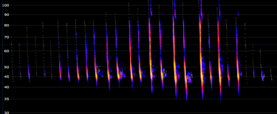
Above: Long-eared bat (Nyctophilus spp) or Southern myotis (Myotis macropus) - these bats are indistinguishable based on spectrogram analysis
Above: Chocolate wattled bat (Chalinolobus morio)